Escalation, LD & final bill
The three commercial heads most often left in spreadsheets — price adjustment, liquidated damages and closure — computed on the contract's own formulas and wired into the certificate.
- Commercial manager
- Finance
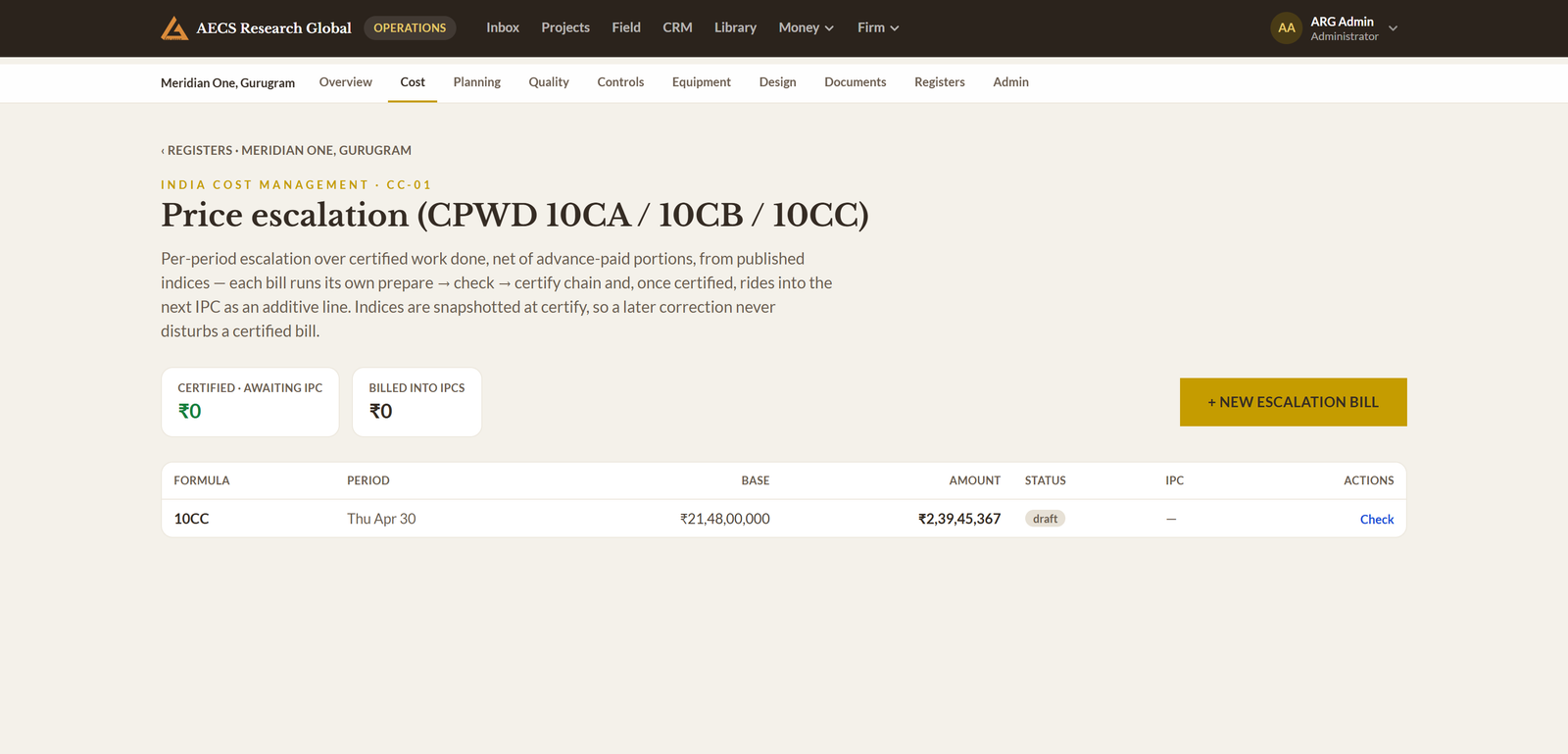
On a contractor's desk. Escalation claims are frequently under-recovered simply because the index workings were never kept month by month. And a final bill submitted with open blockers invites a settlement discount — the readiness gate exists to stop that happening.
What it holds
Price adjustment on the contract formula
Component weightages, base and current indices, and the adjustment per bill period — kept monthly so the claim is a report rather than a project.
Liquidated damages exposure
LD computed against the contractual milestone dates as adjusted by granted EOT — so the exposure you carry in your accounts is the exposure the contract actually supports.
Advances, retention and recovery
Mobilisation and material advances with their recovery schedules, retention held and released against the contract's own thresholds.
Final-bill readiness gate
A checklist the system enforces: measurements closed, variations decided, NCRs cleared, advances recovered, retention position agreed. The closing certificate will not pass while any of them is open.
What it produces
- Escalation statement per bill period with index sources
- LD working with the EOT-adjusted dates applied
- Final-bill readiness report — what remains, and whose it is
What it will not allow
- Certifying a final bill with open blockers
- Over-recovery of an advance
- Escalation on an unsourced index